
Rowlett Previous Residents Source Table
Rowlett is split between two county record systems, so the county is the first decision. Dalrock Road generally marks the practical dividing line: addresses west of it route to Dallas County and addresses east of it route to Rockwall County. Confirm that route with the parcel, city map, county map, or legal description before ordering a document.
| Source | Years It Covers | Where Held | What It Shows |
|---|---|---|---|
| Dallas legacy deed index books | 1846-1963 | County-linked QuickLinks and clerk/counter route | Grantor and grantee book references; image or order access varies |
| Dallas official-record portal | Current records; certified through 2026-08-20; start not stated | Dallas County official-record search | Indexed terms, document types, dates, and OCR scope |
| Rockwall deed microfilm | 1848-1901 | Rockwall County Library and county microfilm | Historic instruments, often keyed by names and legal descriptions |
| Rockwall property portal | Current; start not stated | Tyler property-record route | Property index and copy route, subject to omissions or redactions |
| Regional telephone directories | Selected 1955-1999 runs | UT citation and DPL/Rockwall-area shelves | Listed name, address, and phone; not a complete household roll |
| Area-wide directory | 2005-06 | Library collection, call no. 384.625 ARE | Regional residential and business listings |
| Federal census | 1850-1950 generally, subject to the 72-year release rule | NARA and library family-history sources | Household composition on the census date |
| Rockwall newspapers | Selected 1886-2002 runs | Microfilm and digital reel | Obituaries, notices, legal announcements, and community events |
Begin with the record nearest the date being tested. A current parcel account and purchase deed usually anchor a recent trail. Earlier Dallas work may move to legacy books, while older Rockwall work may depend on the microfilm route. Directories and newspapers are then used to test who lived there before, rather than to replace the deed chain.
The Dallas County official-record portal is the current index layer for a Dallas-side property search.
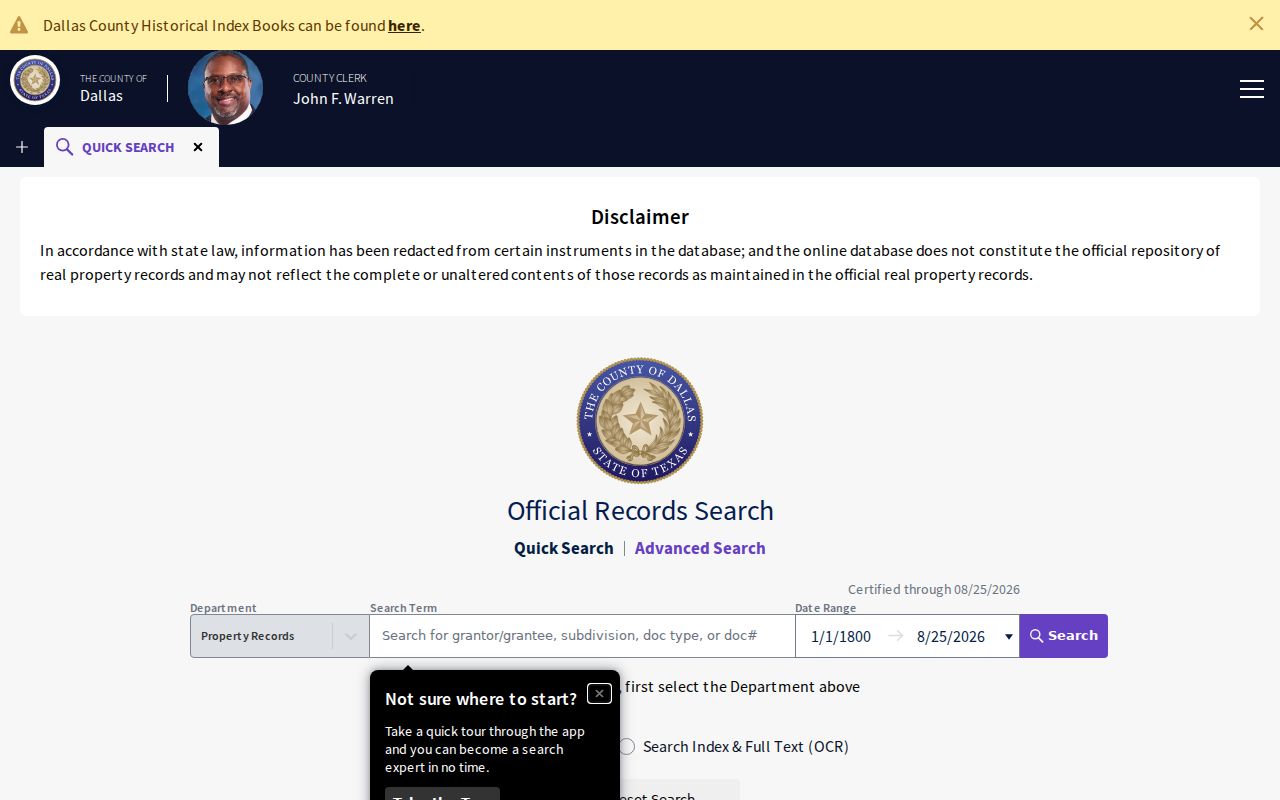
The portal shows the department, term, date, and index or OCR scope used to narrow a recorded-document search. Its certification date does not establish a full online start year.
Rowlett Previous Residents Start With the Parcel
Before following names, save the parcel or account number, situs address, owner of record, mailing address, and legal description from DCAD or the Rockwall tax and property search. The situs address is the physical parcel. The mailing address may be a different residence, an agent, or a tax-bill destination, so it is not proof that a person lived at the property.
A legal description is the recorded property identity, such as a subdivision lot and block or an abstract and survey description. It is especially important when a subdivision, replat, annexation, rural-route conversion, or changed street numbering makes an old address hard to find. Keep the current description with the account number before shifting to a clerk index.
Rowlett Previous Residents Deed Chain
A recorded transfer chain identifies owners, not every person who occupied an address. Begin with the current owner as a grantee, the person who received the purchase deed. Read the instrument for the seller, recording date, instrument number, subdivision, lot, block, and any referenced plat. Then find that seller as an earlier grantee and repeat. Each link should be controlled by the legal description and document date, not by a name alone.
- Confirm the county and capture the current parcel account and legal description.
- Search the current owner as grantee in the county deed index and locate the purchase instrument.
- Record the grantor, or seller, together with the instrument number, date, and property description.
- Search that grantor as an earlier grantee, then compare the description before accepting the next deed.
- When the chain reaches a parent tract, plat, abstract, or survey, switch the search terms from the street address to those recorded descriptions.
- Use legacy books, microfilm, a clerk counter, library holdings, or a request route when the online index does not reach the needed period.
- Grantor
- The person or entity transferring an interest in a recorded instrument.
- Grantee
- The person or entity receiving that interest. In a purchase deed, the grantee is usually the buyer.
- Chain of title
- The dated sequence of recorded transfers tied to the same parcel or legal description.
- Legal description
- The parcel description used in recorded instruments. It is stronger than a street label for tracing older transfers.
Dallas Records Before 1963
Dallas County's official-linked legacy route identifies deed index books from 1846 through 1963. The current public portal displayed a certification date of August 20, 2026 during research, but it did not state when its complete online coverage begins. Treat the current screen as a useful index layer, not proof that every older Dallas instrument is searchable there.
For a Dallas-side Rowlett address before 1963, move through the legacy books, clerk counter, microfilm, Dallas Public Library, Texas State Library, and FamilySearch catalog searches. The document image, order route, and certification availability should be checked for the individual result. A request can be more precise when it includes grantor or grantee, instrument number, document type, property address, city, and the copy choice.
Dallas County's request form distinguishes a plain copy from a certified copy and asks for the person requesting it, property or instrument details, and contact information. The research notes $1 per page for a plain Dallas recorded-document copy and $1 per page plus $5 for certification. Those charges do not change the need to identify the right instrument first, especially when a similar surname appears in several deed books.
Rockwall's Rowlett Previous Residents Trail
On the east side of Dalrock Road, Rockwall County Library's microfilm route is the key historical fallback. Its deed records cover 1848-1901, and the collection also includes marriage and probate indexes, court minutes, census film, birth and death material, and local newspapers. The current Tyler property portal has no stated complete start year in the researched materials.
The Rockwall County Library microfilm collection brings the deed, census, newspaper, probate, and court-minute material together.
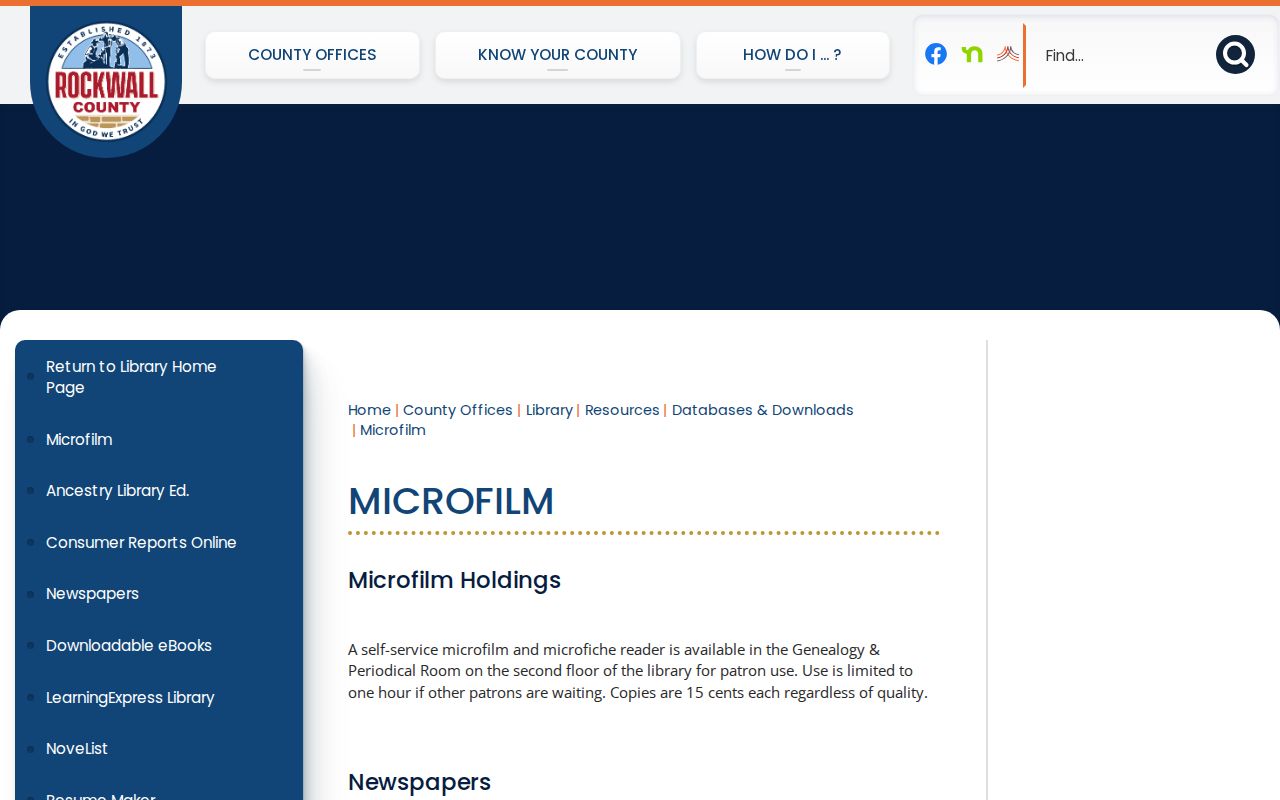
That physical route matters when names or legal descriptions predate the web index. Rockwall County warns that the public online database is not the official, complete, unaltered repository, and qualifying individuals can seek omission or redaction under the provisions that took effect June 20, 2025.
Rowlett Past Residents in Directories and Census
Once the deed chain establishes the parcel, the household trail asks a different question: who lived there before? Regional telephone and criss-cross directories can pair a listed name with an address, then a released census schedule can place a household at a date. The regional directory shelves are described in more detail through the Rowlett city directory collections.
The Dallas History & Archives collection is a source for directories, maps, newspapers, and other records that can test the address trail.
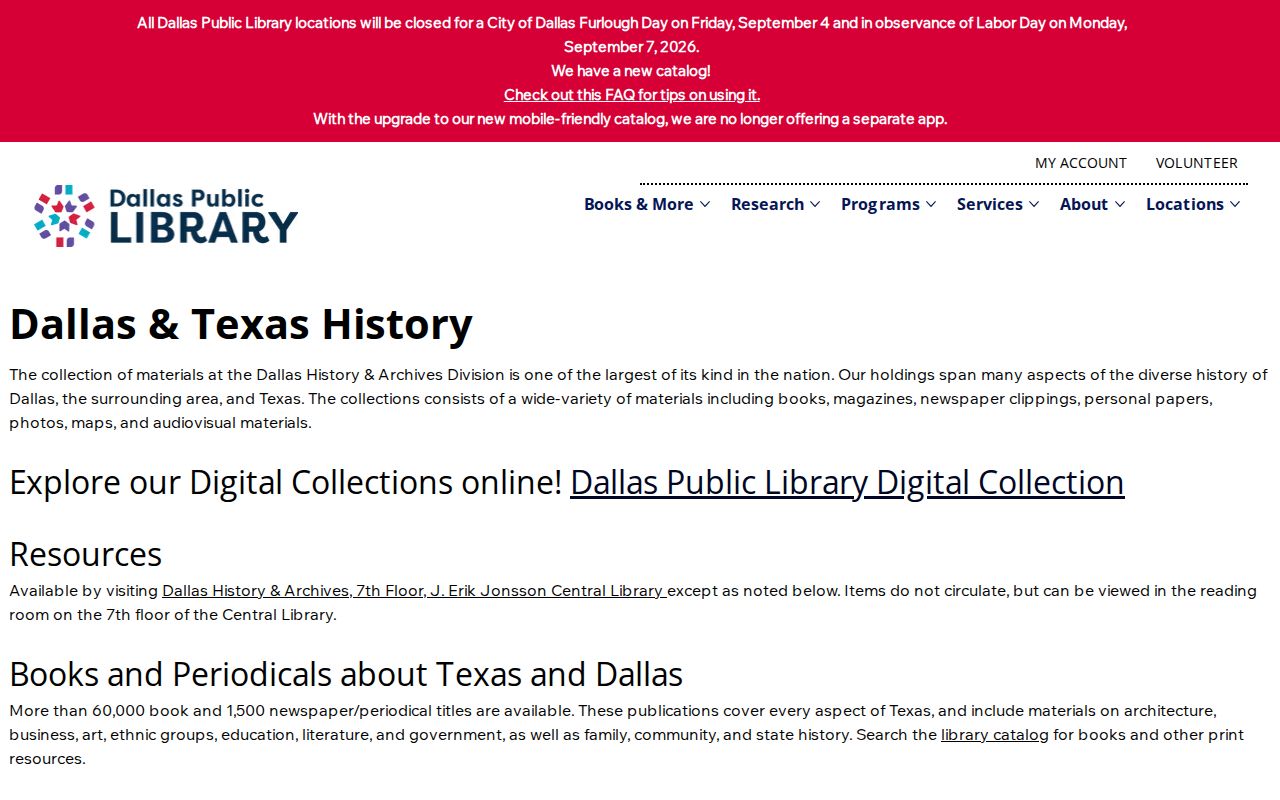
Use an address from a directory as a dated clue, then compare it with the census, a deed, or a newspaper notice. A directory listing does not establish ownership, and a census record reflects the household only on its census date.
- Match the confirmed address to the nearest available regional directory volume.
- Preserve the printed name, initials, locality, address, telephone, volume year, and page.
- Check a criss-cross or address-ordered section when available to see the listed household at that address.
- Pair the date with the closest released federal census year, allowing for older county labels and boundaries.
- Use a newspaper notice, obituary, probate filing, or later deed to test a move, death, heir, or change in ownership.
Rowlett Previous Residents at Trail Endpoints
Obituaries, probate, and newspapers can close a dated gap in a property history. They may identify a death, executor, heir, former address, organization, or public notice that helps distinguish two people with the same name. Sensitive estate material can be restricted, so an index result is only a prompt to check the clerk's available file or copy route.
Rockwall newspaper coverage has gaps. The Rockwall Success is missing the 1966-67 reel, while its surviving material includes longer 1940-41, 1946-65, and 1968-92 runs. Dallas Public Library provides a complementary Dallas Morning News route for 1885-1984 through library services. An unsuccessful keyword search should be followed by a date and page browse or a second newspaper.
Gaps in Rowlett Previous Residents Research
No verified Rowlett-specific Sanborn sheet or year run was located. There is also no identified dedicated Rowlett house-history guide that guarantees a complete service. Maps, directories, county records, newspapers, and genealogy staff remain the documented alternatives. Do not fill an address gap by assuming a map or local directory exists for the needed year.
The national 1890 census loss creates another known break. Rockwall holds a Union Veterans and Widows schedule, but that narrow schedule is not a complete population list. Changes in platting or a move from a subdivision lot to a parent tract can also interrupt the chain. The recorded legal description is the bridge across those changes.
City permit material can add a construction or alteration date, but the researched MyGov information did not establish public unauthenticated historical search fields. A focused public-information request should ask for existing address, permit-type, date-range, inspection, or certificate records rather than a newly created narrative.
Limits on Rowlett Previous Residents Records
Previous residents research is best used for personal history, family history, or understanding the dated record of one property. It must not be used to watch, contact repeatedly, harass, or harm a living person. Texas law restricts stalking and public-record use does not override address confidentiality, redaction, voter-file, or motor-vehicle privacy protections.
Lawful use. Verify a historical conclusion against the custodian that holds the record, and leave protected or sensitive details out of personal notes shared with others. A deed identifies a recorded transfer, not permission to track the people connected to it.