
Rowlett City Directory Collection Table
No verified, standalone Rowlett-branded city-directory run was located. The useful record trail instead sits in regional telephone and address books that include Rowlett with Garland, Rockwall, Sachse, Wylie, and other nearby places. A listed name is a historical lead, not proof of ownership, current occupancy, or every person in a household.
| Collection | Years | Where Held | Access |
|---|---|---|---|
| Garland Telephone Directory | Selected 1955-1999 runs | UT Center for American History citation and local catalog routes | Catalog or library finding aid |
| Southwestern Bell regional volumes | 1990-91, 1993, 1998-99 | DPL and Rockwall-area shelves/catalogs | Library collection |
| Garland/Rowlett area-wide directory | 2005-06 | Rockwall-area library catalog, call no. 384.625 ARE | Confirm onsite or circulation status |
| Greater Dallas White Pages | April 1976 | Portal to Texas History | Free page images and OCR |
| Greater Dallas Yellow Pages | 1998/99 and 2003 | Portal to Texas History | Free digitized volumes |
| Dallas city directories | Cataloged 1973 and selected 1983-91 volumes | Dallas Public Library History & Archives | Reading-room research |
Use the collection named on the row, not a modern city boundary, to judge coverage. A regional service area may place a Rowlett address beside Garland or Dallas entries. The selected runs also leave gaps, which is why a search should be recorded year by year rather than assumed continuous.
Why Rowlett City Directories Are Regional
The Garland Telephone Directory is the longest identified regional sequence. The cited volumes include April 1955, January and November 1957, May 1959 through 1971, April 1974 through 1978, May 1979 through 1987, July 1988 through 1996, and August 1999. They can place a residential or business name beside an address and telephone number, but the run is selected rather than a complete annual shelf.
Later Southwestern Bell books name Rowlett among a wider Richardson, Garland, Plano, Addison, Allen, Lucas, Parker, Renner, Sachse, and Wylie service area. The 2005-06 area-wide volume adds Mesquite, Seagoville, and Sunnyvale. That wider geography is useful when a family moved a short distance, yet it also means a Rowlett city-directory search must test nearby locality labels and exchanges.
The regional pattern also changes how an absence should be read. A name that does not appear in one Garland volume may have been listed in a different service-area book, omitted from that issue, indexed under initials, or located through a nearby city label. Keep a note of the exact book searched before concluding that the household was not in the area.
Rowlett City Directories at Dallas Library
Dallas Public Library provides the deepest nearby directory shelf. Dallas History & Archives is on the seventh floor of the J. Erik Jonsson Central Library, where materials are noncirculating and used in the reading room. Its holdings include yearly city, telephone, and criss-cross directories, maps, yearbooks, Dallas County record deposits, and Dallas Genealogical Society indexes. The Genealogy collection on the eighth floor adds microform finding aids, surname-indexed family files, cemetery and funeral-home indexes, and onsite family-history databases.
The Dallas Public Library genealogy collection shows the library setting behind these historical searches.
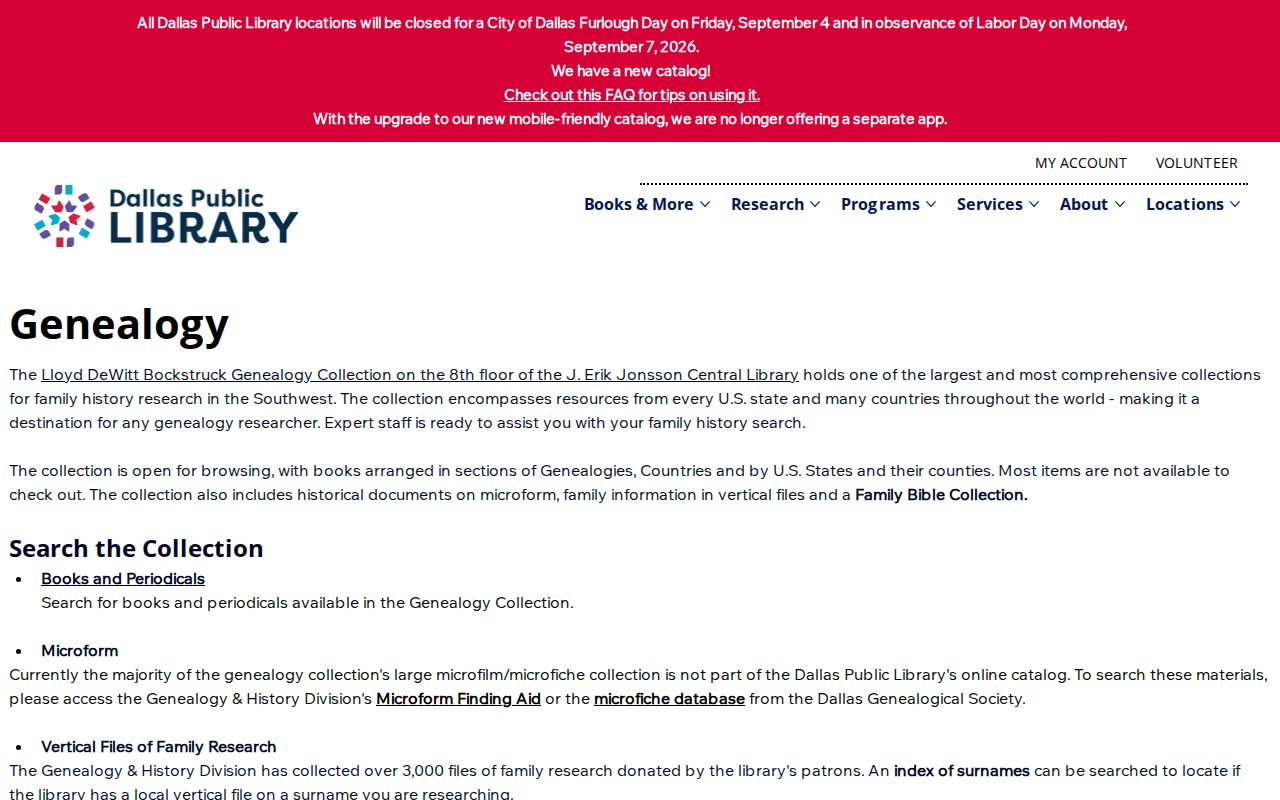
Those shelves supply companion sources when a telephone listing is too brief, especially a map, yearbook, family file, obituary index, or county record deposit that can clarify an address.
Reading a Rowlett City Directory Page
The digitized April 1976 Greater Dallas White Pages has a regional alphabetical run, surname and name lines, street address, locality, telephone number, OCR text, and page-image controls. A Rowlett-related surname on that page does not prove that every entry is in Rowlett. It does show the layout to capture before comparing another volume.
The digitized Greater Dallas White Pages page preserves both the OCR and image view of a historical directory entry.
Copy the visible spelling, locality, address, and phone before relying on OCR alone. Initials, locality abbreviations, and extension marks can change how a later catalog or newspaper search behaves.
| Name line | Surname and given name or initials in the alphabetical sequence. |
|---|---|
| Address | Street address and, where printed, a city or locality label. |
| Telephone | The listed number, exchange, PBX, or extension mark. |
| Context | Page header, surrounding surnames, and any visible directory section. |
| Publisher conventions | Spouse, widow, business, route, or other marks only as defined in that volume's front matter. |
- Criss-cross directory
- An address-ordered or street-ordered companion to an alphabetical book. It can point from an address to a listed household.
- Householder index
- A listing organized around the named household, which may not include every person at the address.
- Abbreviation key
- The publisher's explanation of initials and marks, usually in the front matter. Its meaning should not be guessed from another publisher's book.
Rowlett City Directory Years in Sequence
A short timeline keeps the regional record sequence visible. It also prevents a researcher from treating a cataloged date as a promise that every intervening year survives or contains the same kinds of entries.
- 1955: The identified Garland telephone run begins with an April volume.
- 1957-1971: Additional Garland issues include January and November 1957, then selected May volumes beginning in 1959.
- 1976: Greater Dallas White Pages became a digitized April volume with OCR and page images.
- 1990-1999: Southwestern Bell regional books and later Garland volumes provide Rowlett-area coverage.
- 2005-06: The cataloged area-wide directory extends the regional shelf into a later period.
Dallas urban directories and national directory collections can fill context around those dates, though their Rowlett coverage may be absent or regional. Write down the exact volume title and page each time. That makes the result reproducible if the record is later checked at a library counter.
Morris Before the Rowlett Directory Name
Old-name searching matters here. The local post office was first called Morris under postmaster Austin Morris before the railroad-era name Rowlett prevailed. A historical search that uses only the modern place name can miss a newspaper notice, catalog subject, or family reference filed under Morris. The first post office name is a search variant, not evidence that every Morris entry refers to the community.
Railroad arrival in 1889, Bankhead Highway traffic in 1921, incorporation in 1952, and Lake Ray Hubbard's completion in 1971 also help explain why older references may describe the same area through changing local context.
Rockwall Reels Beside Rowlett Directories
Rockwall County Library's microfilm room is a strong companion for the east side of Rowlett. The self-service reader is in the Genealogy & Periodical Room on the second floor. Copies cost 15 cents, and the digital newspaper reel is keyword-searchable on library computers or Wi-Fi, although a date and page browse may work better when image quality limits a keyword search.
The Rockwall Success reel has a meaningful 1966-67 gap. It also has scattered issues for 1888, 1889, 1891, 1909, 1911, 1927, 1932, and 1933, longer runs for 1940-41, 1946-65, and 1968-92, plus pieces from 1996-2000. A missing reel should prompt a second newspaper or record type, not an assumption that an event did not occur.
The room also lists 1850 Texas census film, county material for 1860 through 1890 where available, and 1900, 1910, and 1920 Rockwall County material. Onsite Ancestry Library and TexShare access to HeritageQuest can help test a name found in a regional directory. The one-hour reader limit applies when others are waiting, so page and date notes are useful before arriving.
Tracing Rowlett City Directories and Census
Use city directories as a sequence of dated observations. Start with the earliest confirmed name, preserve every printed address and phone, then compare the next available regional volume. A move, changed locality label, or different telephone exchange is a lead to test with a census, newspaper, or deed. It is not enough by itself to establish an ownership change.
- Find the first confirmed listing and save the volume title, year, page, spelling, address, and phone.
- Check the next available regional directory and note whether the household remains at the same address.
- Use the criss-cross portion, if present, to compare listed households at that address or nearby addresses.
- Pair the sequence with released federal census years from 1950 backward, taking account of historic county and boundary labels.
- Use newspaper notices, obituary indexes, probate, or deeds to test a move, death, heir, or property transfer.
The 1890 federal population schedules were largely destroyed nationally. Rockwall's Union Veterans and Widows schedule is a narrower surviving source, not a complete replacement. For a modern address-keyed ownership trail, use the Rowlett street directory route rather than treating an old phone book as a current parcel record.
Limits of Rowlett City Directory Evidence
Directory absence has several ordinary explanations: a volume may be missing, the household may be unlisted, the name may be indexed under an initial or variant, or the relevant service area may use a nearby locality. The collections can show a listed name, address, phone, or local institution at a point in time. They do not identify all past residents, establish protected household composition, or settle a title question.
Dallas Public Library and Rockwall microfilm provide the practical fallback when a web search ends at a catalog record. Pairing regional directories with census film, deeds, probate, maps, and newspapers gives a more defensible historical trail than any single page.